
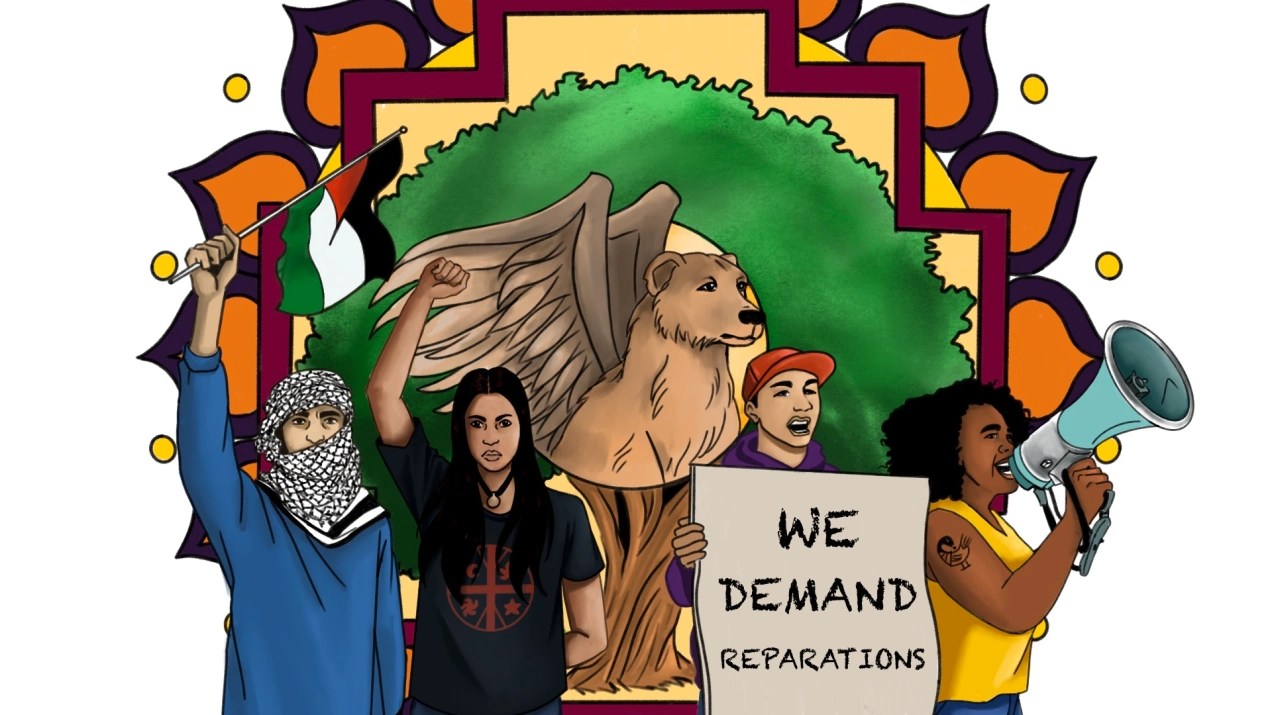
On this day community organizers are invited to formulate demands and actions aimed at repairing colonial damage towards the Global South. During the first edition of the conference, the intention was expressed to formulate a Decolonial manifesto with concrete demands for reparations towards the Dutch state and other colonial institutions. Aralez took the initiative to shape this manifesto based on the input of the conference in 2022 and will present an initial draft of this manifesto at the conference. During the conference, participants can provide feedback on this concept and break-out sessions will discuss how we can implement concrete campaigns and other follow-up steps. The conference is mainly intended for people who want to actively contribute to putting reparation measures on the agenda and realizing them for the Global South.
you can watch back the plenairy part of the conference here
Practical information
Date: Saturday, April 20th, 2024
Time: 10:00-17:00 (with optional dinner afterwards)
Location: Buurthuis de Bol
Address: Zilverberg 68B, 1025 CJ Amsterdam
Admission Fee: €15 , inclusive of food (payment possible on location)
*Please e-mail us at stichtingaralez@gmail.com if you are not able to afford entrance fee of €15
Why this conference?
This conference has two intended outcomes. The first is a collective manifesto with concrete demands that can be launched in the public debate when it comes to reparations and repairing colonial damage. The second is to come up with drafts for concrete campaigns to realize the reparation demands. The conference focuses on grassroots organizations and collectives that want to contribute to the decolonial movement and/or have concrete initiatives aimed at repairing colonial damage in the Netherlands and/or in solidarity with initiatives from the Global South.
The conference will take place on April 20th. This date has been intentionally chosen in the spirit of the Bandung Conference, which took place from April 18-24, 1955 in Bandung, Indonesia. It was the first conference to unite the former colonized countries of Africa and Asia to develop a strategy and vision for a new decolonial world civilization.
Program Schedule
[Speakers bio’s below]
| 09:30 | Walk-in |
| 10:00 | Introduction |
| 10:15 | Opening speech by Cesar Taguba and collective opening ritual by moves of resistance |
| 10:30 | Presentation of Decolonial manifesto |
| 11:15 | Q&A |
| 11:20 | Performance by Marikit |
| 11:25 | Panel on solidarity campaigns and action with global south with Kjelld kroon, Max Koffi and Hacer Karadeniz |
| 12:00 | Q&A with panel |
| 12:30 | Lunch break |
| Work session part 1: Analytical perspective | |
| 13:30 | room for pitches & explanation of work sessions. |
| 13:45 | Discussion reparation demands in the manifesto: what are strong points, challenges, things that are already happening in terms of actions or campaigns that we can build on? |
| 14:30 | Art performance Sofaya |
| Work session part 2: Strategic perspective | |
| 14:45 | Discussion follow-up steps: what are important follow-up steps/actions to get the reparation demand realized, which parties should be involved, how can we put this reparation demand on the political agenda? |
| 15:30 | Break |
| Work session part 3: Practical/Organizational perspective | |
| 15:45 | Discuss the role you want to play in the reparation demands: which follow-up steps do you want to take in terms of organization and communication etc.? |
| 16:15 | Plenary feedback |
| 17:30 | Dinner |
| 19:00 – 20:30 | Drinks and music:/ Open Mic |
Information on Speakers:
Cesar Tomilas Taguba is an indigenous Igorot from the Philippine Cordillera and serves as a representative of the Cordillera Peoples Alliance (CPA) Elder in Europe. He arrived in the Netherlands in the 1980s as a political refugee. Throughout his time in the Netherlands, he has steadfastly advocated for Indigenous rights and culture. As a co-founder of MABIKAs Foundation-The Netherlands and in partnership with other diasporas, he works tirelessly to promote the right to self-determination, defense of ancestral land, and culture of resistance and further ensure that indigenous knowledge is passed on to future generations.
Kjelld Kroon comes from Rincon/Bonaire and studies in Leiden. He is an activist for Bonaire’s political rights and did an internship at Human Rights Bonaire in 2021. As a philosophy student; Global and comparative perspectives (Leiden) he specializes in decolonial and political philosophy. He was also part of the court case against the Dutch government for Climate racism due to lack of environemntal policies of the Dutch government in Bonaire.
Max Koffi Director Africa In Motion, Founder Equal Trade Alliance, Advocate for Africa’s economic decolonization. Equal Trade Alliance is a Campaign Organization that was established to promote equal redistribution of wealth along the value chains of African raw materials and natural resources.
Hacer Karadeniz union director at FNV labour union and member of FNV Palestine working group, motivated to organize workers for actions and the ethical re-investment of pension funds of working people.
Chris Kaspar de Ploeg (1994) is an investigative journalist, grassroots organizer, speaker, moderator and author of Ukraine in the Crossfire, project coordinator for Arts of Resistance and cofounder of Aralez
Pravini Baboeram is an artist and activist, creating art to contribute to social change. She has been engaged in community work, translating decolonial theory to grassroots initiatives that challenge institutional racism and colonial legacies and is a co-founder of Aralez.
Max Arto de Ploeg is a community builder, grassroot organizer, moderator, musician, teacher, and public speaker. He is cofounder of Aralez and coordinator at Together Against Racism, and Decolonial Learning Sessions.
Performers;
Marikit Saturay is a concous hip-hop artist with razor sharp lyrics aganst fascism and neo-colonialism. She believes that without the power of music there can be no systemic change. She was born in the Philippines and grew up between political violence and human rights violations by a fascist government. The local population had to defend their country against capitalist mining companies from abroad, and her family eventually fled to the Netherlands. Marikit put her life-story into her music and performs regularly at political events.
SOFAYA
SOFAYA pays homage to South Africa’s rich heritage, sharing a mixture of musical traditions, histories, and evolutions across decades and genres. Inspired by legends such as Hugh Masekela, Abdullah Ibrahim, Busi Mhlongo, Chris McGregor’s Brotherhood of Breath, Zim Ngqawana and more, their vision is rooted in respecting and acknowledging the land, its elders, and all those who are currently paving new ways.
Through interpretations of classics and original compositions, they aspire to share South Africa’s profound beauty and enduring struggles.
Prepare to be transported by their heartfelt melodies and infectious grooves. It’s a journey that’s sincere, vibrant, provocative, and wild, yet soothing, soulful, and filled with kindness and hope.
For this performance they’ll be playing in a trio formation
James McClure – trumpet
Zenzele Mthembu-Salter – bass
João Guerra – drums
 Grassroots network and organization for decolonization