
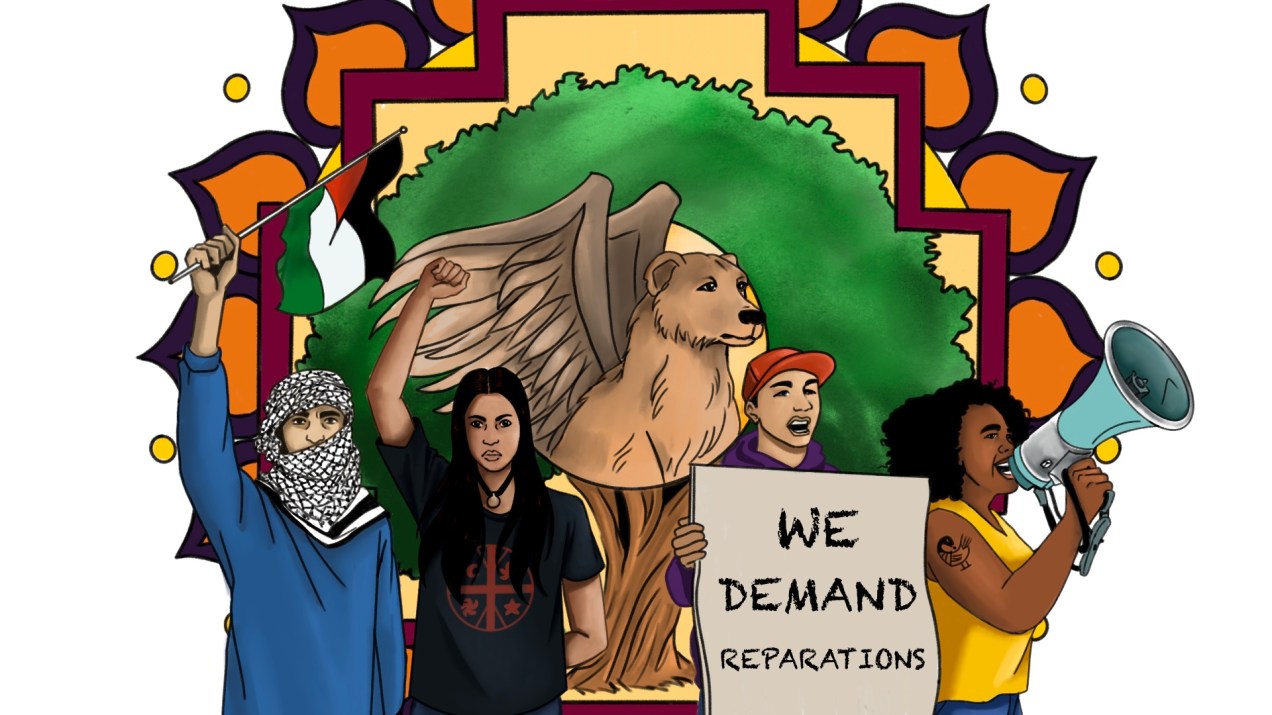
The question of reparations in a Shifting World Order
Date: April 18th, 2026
Location: Buurtcentrum De Horizon, Hembrugstraat 156, 1013 XC Amsterdam
Time: 11:00-18:00 (doors open 10:30) followed by dinner 18:00–20:00 (optional)
Sign up here: registration link
On April 18th, 2026, Aralez organizes the Pan-Decolonial Reparations Conference 2026 — a gathering of activists, scholars, organizers and community leaders committed to building concrete strategies for reparations and self-determination in a rapidly shifting global order.
As imperial power realigns and international law increasingly reveals its limits, urgent questions emerge:
- Who are reparations addressed to in a world structured by colonial power?
- What does accountability look like when global institutions fail?
- And how do we build real pathways toward justice and reparations from the ground up?
Inspired by the spirit of Bandung (1955), this year’s conference focuses not only on analysis — but on strategy both in theory and practice, and is build upon the Pan-Decolonial Reparations Manifesto.
This conference has been made possible by Milieudefensie, trough the “initiatieven Loket”
Program:
Walk-in and registration: 10:30-11:00
Plenary session: 11:00-12:45 including opening ceremony
What Would Reparations Actually Look Like — and How Do We Get There?
We begin by situating reparations within the changing international framework:
- The erosion of international law
- The tension between anti-imperial struggle and global institutions
- The appropriation of UN frameworks by Global South movements
The central plenary question:
What does reparations look like in a shifting world order — and what strategies can bring them into being?
with speakers in panel: Aki Negate, Eva Yelina Silva Walker, Ahmed Abofoul
Themes include:
- Self-determination beyond NATO and Western hegemony
- The limits and possibilities of international law
- Accountability in a colonial world order
- Reparations as structural transformation, not symbolic gestures
Lunch Break 12:45-13:45
Building Practices & Strategies of Reparations
Workshops round number 1 – 13:45-15:15
Break 15:15-15:30
Workshop round number 2 – 15:30-17:00
This year’s workshops focus explicitly on strategy:
How do we organize toward reparations under current geopolitical conditions?
Topics include:
Reparations and healing in Community with “Rest and Resist”
Healing, resistance and collective restoration with Zahira Mous & Tania S. Shoukair
Grassroots Litigation & Movement Partnerships
How community organizing and legal strategies can reinforce each other with Churmer Bomba
Museums as Tools for Reparations
Memory, narrative and institutional transformation with Priya Swamy
Political Strategy & Lobbying
How do we put the right people in power? What is our strategy toward the state? with Ian van der Kooye
Workshops are limited in size and selected upon registration.
Collective Strategy Session 17:00-18:00
In the late afternoon, we shift from discussion to collective imagination and practice.
Through collective drawing, readings and shared reflection, we ask:
- What infrastructures of reparations do we need?
- What resources can we share?
- What practices must we build across movements?
Dinner & Informal Gathering 18:00-20:00
We close the day with shared food, drinks and music — continuing conversations and strengthening alliances.
Sign up here: registration link
Bio speakers & workshops:
Plenary part:
Aki Negate is a sociologist and researcher with a focus on pan-Africanism. He is co-writer of the famous news videos of The Niteshop, teaches sociology at Erasmus University Rotterdam and is currently working on a dossier on Ethiopia for the Tricontinental Institute for Social Research
Ms Eva Yelina Silva Walker has been ambassador of the Republic of Cuba to the Netherlands since February 2025. Amb; Yelina began her career as legislation specialist in the Ministry of Finances and Prices. In 2006, she joined the Ministry of Foreign Affairs. She then worked as Third Secretary in the Legal Department and Second Secretary/<second Consul at the Consulate General of Cuba in Montreal, Canada. She served as Advisor at the Independent Legal Department and was Ambassador to the Democratic Republic of the Congo between 2018-2021. She then became Director of International Law at the General Directorate of Multilateral Affairs and International Law.
Workshops: (more info on Ian van der Kooye & Priya Swamy will follow soon)
Rest and Resist: brings together Activists, artists, healers using art & therapeutic practices in community. Injustice thrives on exhaustion & separation, we resist that. With: Zahira Mous: dance theater director, choreographer, performer, somatic healing group facilitator and community organizer & Tania S. Shoukairr: certified somatic coach, writer, poet and matriarch
Churmer Bomba is a socially driven professional and activist, born on Bonaire. As a Community Mobilizer at Greenpeace Netherlands, he works to strengthen connections between the Caribbean islands and the European part of the Netherlands. His goal is to anchor Caribbean perspectives in Dutch policy, with particular attention to the socio-economic context of the islands.
Support Aralez — Help Build Autonomous Decolonial Spaces
Aralez is a pan-decolonial collective working on political education, community building, and collective liberation. To remain independent from subsidies and strengthen our own infrastructure, we are building a community of monthly donors.
Want to support sustainable decolonial organizing?
Become a recurring donor and help us stay autonomous.
Your donations help tremendously! Would like to donate?
You can donate to IBAN: NL67 TRIO 0320036073 t.n.v. Stichting Aralez
Tip: you can also make a monthly donation if you like. That helps us create financial stability
 Grassroots network and organization for decolonization